Introduction
You've been there: standing in a hospital corridor, gripping a printed map that doesn't match the hallway you're in, looking for an elevator that seems to have vanished.
Or maybe it's a sprawling office building, a hotel with three towers, or a big-box retailer where every aisle looks the same.
Many visitors struggle with unfamiliar buildings, and the cost isn't just frustration. Patients arrive late to appointments, customers walk out before they buy, and employees lose time giving directions instead of doing their own jobs.
Good wayfinding signage fixes this by blending design, psychology, and legal compliance into a system that guides people without a second thought.
This article breaks down the four core types of wayfinding signage and walks through 10 real-world examples across industries. It also explains why ADA compliance isn't optional for many of these signs.
Key Takeaways
- Wayfinding signage falls into four categories: directional, identification, informational, and regulatory
- Strong examples span healthcare, hospitality, retail, corporate, education, and multifamily housing
- Identification and directional signs need ADA-compliant tactile characters, Braille, contrast, and mounting height
- Partnering with an ADA-specialized manufacturer reduces compliance risk without sacrificing quality or turnaround
What Is Wayfinding Signage?
Wayfinding signage is the system of signs, symbols, color-coding, and maps that help people move through a physical space with confidence. It's the difference between a visitor quickly finding Suite 302 and one wandering three floors before asking a stranger for help.
According to the Society for Experiential Graphic Design, wayfinding covers both the process of choosing a route and the physical elements — signs, maps, environmental cues — that support that process. Signage is one piece of a bigger system.
Here's where it gets more technical: not every wayfinding sign carries the same legal weight.
- Identification signs (room plaques, restroom signs) almost always require tactile characters and Braille under ADA rules
- Directional and informational signs typically only need to meet visual-character requirements, not tactile ones
- Temporary signs displayed for seven days or fewer are generally exempt
For businesses, this matters beyond legal risk. Clear wayfinding reduces safety incidents, cuts down on staff interruptions for directions, and shapes whether a first-time visitor's experience feels organized or chaotic.
The 4 Main Types of Wayfinding Signage
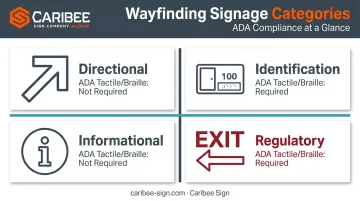
Every wayfinding system, regardless of industry, is built from four functional sign types. Understanding which is which determines what compliance rules apply.
Directional Signage
Directional signs point people toward a destination. Think arrows, floor-level graphics, or ceiling-mounted signs placed at decision points such as hallway junctions and elevator lobbies, wherever someone has to choose a direction.
These signs usually need visual clarity (contrast, font size, sight lines) but not always tactile treatment, unless they double as identification markers.
Identification Signage
Identification signs confirm you've arrived. Room plaques, restroom signs, and suite numbers fall into this category, and they're the ones most frequently required to include:
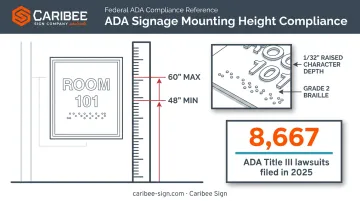
- Raised tactile characters at least 1/32 inch above the background
- Grade 2 contracted Braille
- Baseline mounting between 48 and 60 inches above the floor
Informational Signage
Informational signage shares general details, building hours, WiFi passwords, directories, without directing or instructing anyone. It's typically clustered near entrances and lobbies where visitors first orient themselves. Because it doesn't direct or instruct, this signage type typically carries no ADA compliance requirement, though basic visibility guidelines still apply.
Regulatory Signage
Regulatory signs communicate rules such as exit routes, occupancy limits, and no-smoking notices, many of which overlap with OSHA requirements. Exit signage, for example, must use letters at least six inches high, according to OSHA's exit sign specifications.
10 Wayfinding Signage Examples Across Industries
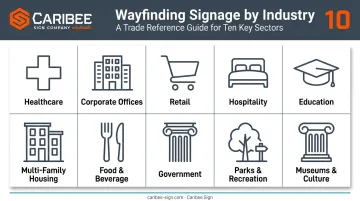
The best wayfinding systems aren't generic. They're shaped by how people actually move through a specific type of building, and by which compliance rules apply. Here's how ten different industries put these four sign types to work.
Healthcare Facility Directional & Room Identification Signage
Hospitals are among the hardest environments to navigate: multiple wings, similar-looking corridors, and visitors who are often stressed or unfamiliar with medical layouts. When Lankenau Hospital restructured its wayfinding around alphabetic zones and coordinated signage, visitor confidence scores rose from 66/100 to 89/100.
Common elements include:
- Color-coded corridor signage marking zones or departments
- Tactile, Braille-inclusive room signs for exam rooms and offices
- High-contrast directional signage at every major junction
Caribee produces exam room and clinical office signs using frosted acrylic and two-tone finishes like teal/turquoise or red/white, giving sign companies an ADA-compliant way to help healthcare clients color-code departments.
Corporate Office Directory & Suite Identification
A branded lobby directory does double duty. It routes visitors to the right suite and reinforces company identity the moment someone walks in. Contentful's Berlin office, an 88,000-square-foot, 120-plus-room space, uses color-coded pictograms, arrows, and Braille to keep a sprawling layout navigable.
For multi-tenant buildings, suite placards paired with a clean directory board cut down on front-desk interruptions and "which floor is this?" questions.
Retail Store Aisle & Department Markers
Overhead aisle signage does the work a floor associate would otherwise have to do. Wal-Mart's Lippincott-designed system, first piloted in Jacksonville, combined department identification, subcategory signage, and color coding to help shoppers self-navigate without asking staff.
- Reduces staff time spent on directions
- Speeds up the overall shopping experience
- Reinforces store layout logic for repeat customers
- Cuts down on repeated aisle questions during peak hours
Hotel & Hospitality Floor and Room Signage
Guests arriving after a long travel day don't want to hunt for their room. Ovolo South Yarra uses typographic wayfinding, room names, level directories, and embedded floor graphics to guide guests almost intuitively from lobby to door.
Raised-character, ADA-compliant room numbers remain essential here too, since hotel guest rooms count as identification signage under federal rules.
University Campus Wayfinding Kiosks & Building Identification
Large campuses with dozens of buildings need layered wayfinding: outdoor maps at entry points, building identification signage, and interior directories. Brown University's Lindemann Performing Arts Center received a full signage package covering identification, donor recognition, and code-required signs across five different performance configurations.
Caribee's education-sector work includes building identification signs, campus directory panels, and directional signage, all produced with Braille and tactile elements built in from the start rather than added later.
Multifamily Apartment Directory & Unit Signage
Property directories and unit plaques help residents and delivery drivers alike. In mixed-use developments combining residential towers with commercial space, color coding and type-weight variation (seen in projects like Forum Signage) help distinguish between uses without cluttering the visual environment.
- Directory boards near main entrances
- Unit number plaques at each door
- Accessible-route signage connecting parking to entries
Restaurant & Bar Restroom and Entrance Identification
Restroom signage in food service settings has to check two boxes: ADA compliance and brand cohesion. Pictogram and Braille restroom signs paired with a branded entrance marker keep the guest experience consistent from curb to table.
Mercado Little Spain, a 35,000-square-foot food hall with 16 separate gastronomic stops, used one unified sign system across every vendor to keep navigation simple despite the density.
Government Building Regulatory & Compliance Signage
Public buildings carry heavier compliance obligations than most private facilities. Accessible entrance markers, restricted-area signage, and code-required exit and occupancy signs are standard. Multnomah County's Central Courthouse integrated its wayfinding signage with carved wood details echoing the building's architecture, proving compliance signage doesn't have to look institutional.
Parks & Recreation Trail and Directional Signage
Outdoor recreational spaces need durable, weather-resistant signage that still meets accessibility standards. The National Mall and Memorial Parks wayfinding program includes more than 500 physical signs and directory maps guiding visitors across a massive outdoor footprint.
- Trailhead maps at entry points
- Distance markers along routes
- Accessible-route signage for mobility-impaired visitors
Museum & Cultural Center Informational Signage
Museums combine two needs: helping visitors navigate physically while also communicating exhibit information. MASS MoCA's wayfinding system was designed specifically to handle its unusual mix of open and enclosed gallery spaces.
Caribee's portfolio includes a multi-floor museum directory sign listing "Museum & Arch Tram," "Mezzanine Level," and "Entrance/Ticketing." Produced with integrated Braille in a metallic finish, it's one example of how informational signage and ADA compliance can share the same panel.
Best Practices for Designing Effective Wayfinding Signage
A well-designed sign is useless if nobody can read it in time to act. Effective wayfinding systems share a few consistent habits:
- Keep it simple and legible. Use universal symbols instead of text-heavy explanations. ADA Section 703.5.5 ties minimum character height to mounting height and viewing distance, so a sign viewed from 21 feet away needs noticeably larger text than one mounted at eye level.
- Place signs at decision points. The VA's signage design manual recommends locating maps and directional signs near entrances and at every point where a route decision must be made, not at fixed footage intervals.
- Keep branding and color-coding unified. A single visual language across every sign type (fonts, colors, materials) reduces cognitive load and reinforces trust in the system.
- Design for low-vision and mobility needs. Non-glare finishes and strong light-on-dark or dark-on-light contrast matter, even though federal rules don't specify an exact contrast ratio.
Consistency across an entire signage package is easier when one manufacturer handles production end to end. Caribee produces its ADA, directional, and directory signage in-house using CNC routing and laser engraving, which keeps font rendering, sizing, and finish consistent whether an order is for five signs or five hundred.
Why ADA Compliance Is Non-Negotiable in Wayfinding Signage
Here's the part businesses can't treat as optional. Under the 2010 ADA Standards for Accessible Design, permanent room identification signs must include tactile characters and Grade 2 Braille. Mounting height matters too: the lowest baseline sits at 48 inches, and the highest no more than 60 inches above the floor.
Getting this wrong carries real financial risk. Federal courts saw 8,667 ADA Title III lawsuits filed in 2025 alone. Physical signage isn't the only driver of that number, but non-compliant identification signs remain one of the more common and avoidable triggers for a complaint.
This is exactly why many sign companies don't build ADA tooling and compliance expertise in-house for every job. Instead, they partner with a manufacturer who already has it dialed in.
That's where Caribee Sign comes in. Operating out of St. Louis for over 60 years, Caribee builds ADA signage with in-house Grade 2 Braille translation included on every order, so sign companies never have to source Braille copy separately.
Every sign ships from a single facility with consistent quality control, and the team responds to quote requests quickly and reliably.
For sign companies juggling multiple client deadlines, having one dependable ADA partner means fewer compliance headaches and more consistent results across every project.
Frequently Asked Questions
What is wayfinding signage?
Wayfinding signage is the system of signs, symbols, and visual cues that guide people through a physical space, reducing confusion and helping them reach a destination efficiently.
What are the different types of wayfinding signage?
There are four main types: directional (arrows and route guidance), identification (room and suite signs), informational (directories and hours), and regulatory (exit and safety signage).
What are some examples of wayfinding signs?
Examples include hospital room identification signs, hotel floor directories, retail aisle markers, and campus building identification signage, each tailored to its specific environment.
Is wayfinding signage legally required to be ADA compliant?
Many identification signs and some directional or regulatory signs must meet ADA standards for tactile characters, Braille, and mounting height. Purely informational signage often doesn't carry the same requirements.
How much does a wayfinding signage system typically cost?
Cost depends on material choice, order quantity, and ADA-compliance features like Braille and tactile elements. Requesting a custom quote is the most accurate way to get pricing for your specific project.
Who should design and manufacture wayfinding signage for my business?
Partner with an experienced sign company that specializes in ADA compliance for the design and installation. Look for one that sources from a dedicated wholesale manufacturer, such as Caribee Sign, to ensure consistent quality and code compliance across every location.