This scene plays out daily in offices across the country, and it's not just embarrassing. It's expensive. As companies shift to hybrid schedules and hot-desking, employees no longer have a fixed desk to anchor them. Wayfinding signage has evolved from simple room labels into a strategic system that combines physical signs, ADA compliance, and design logic to move people efficiently.
This guide breaks down the four types of office wayfinding signage, what ADA compliance actually requires, the business case for investing in it, and how to pick a signage partner who won't leave you scrambling before an inspection.
Key Takeaways
- Corporate wayfinding signage relies on four sign categories: identification, directional, informational, and regulatory
- Permanent room signs must meet ADA Standards for tactile characters, Braille, and mounting height
- Consistent signage reduces wasted time, improves first impressions, and limits legal exposure
- Sourcing ADA-compliant signage at scale is easier with a dedicated manufacturing partner
What Is Corporate Wayfinding Signage?
Corporate wayfinding signage is the full system of signs, both directional and identification-based, that answers four questions for anyone moving through an office:
- Where am I?
- Where do I go?
- How do I get there?
- How do I know I've arrived?
It's easy to confuse this with digital wayfinding tools like touchscreen kiosks or mobile apps. Those have their place, but they're not the backbone of office navigation. Physical, ADA-compliant signage is the layer that never goes down, never needs Wi-Fi, and legally has to be there. This guide focuses on that physical layer.
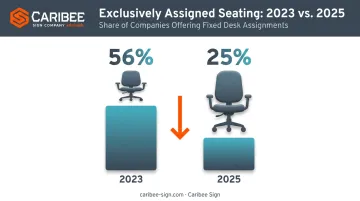
Why does this matter more now than it did a decade ago? Office layouts have changed. According to CBRE's 2025 Americas Office Occupier Sentiment Survey, only 25% of companies now use exclusively assigned seating, down sharply from 56% in 2023.
That means the majority of employees are moving between unassigned desks, floors, and departments on a regular basis.
Without a fixed desk to orient around, static signage becomes the one constant people can rely on. A sign system that's consistent, clear, and properly placed does more work than ever when nobody has a "home base."
The 4 Types of Office Wayfinding Signage
A functional office wayfinding system isn't one type of sign repeated everywhere. It's four distinct categories, each doing a different job at every decision point in the building.
Identification Signage
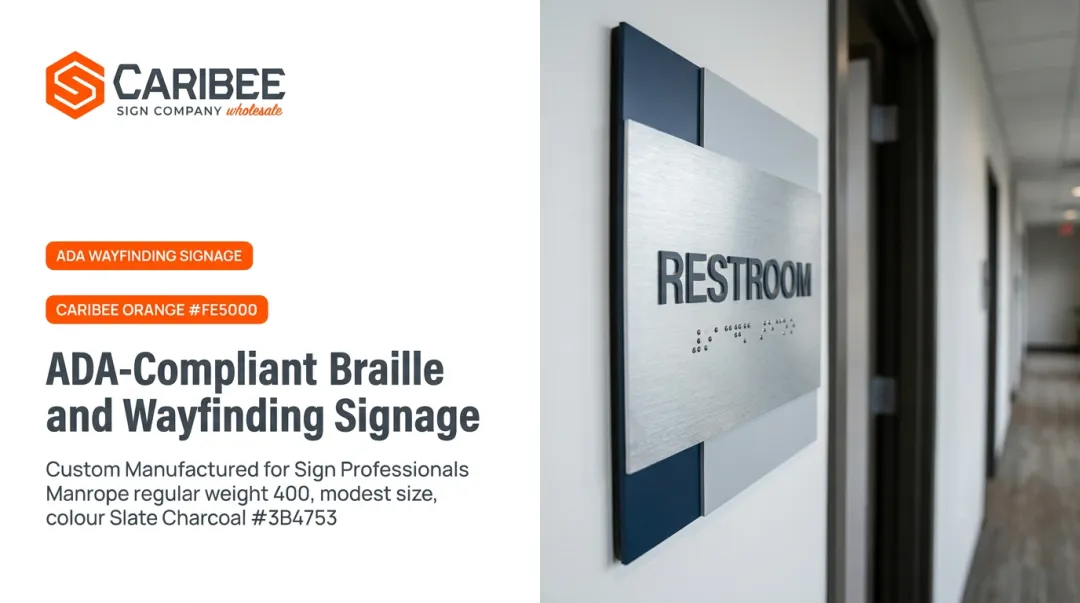
Identification signs confirm you've arrived. Room nameplates, department markers, and restroom signage all fall into this bucket. These are also the signs most likely to require **ADA tactile and Braille compliance**, since they mark permanent rooms and spaces under Section 216.2 of the ADA Standards.
Directional Signage
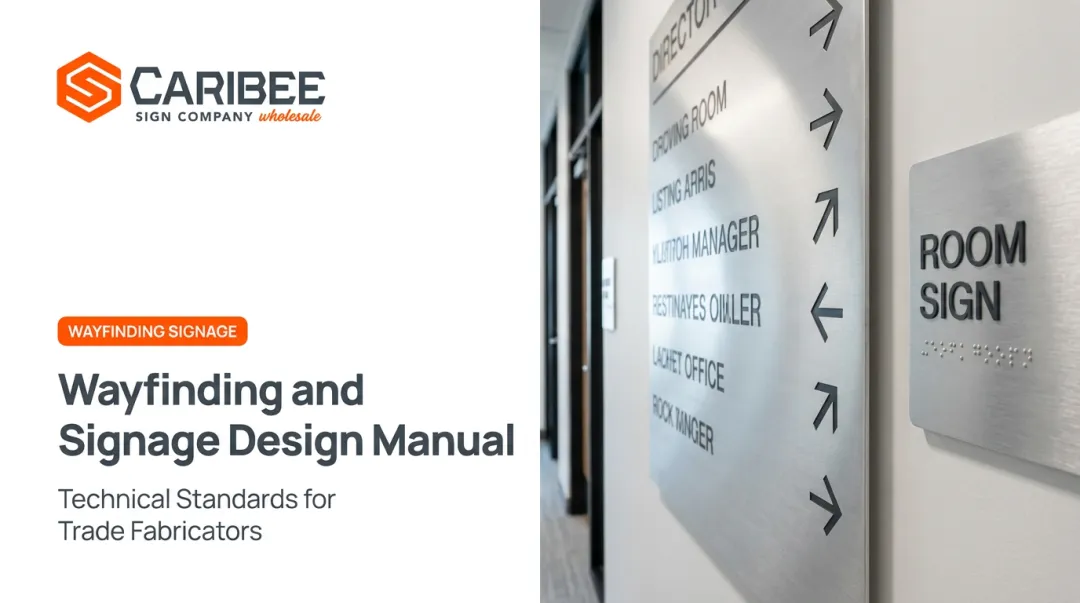
Directional signs point the way. They rely on arrows and consistent visual cues at hallway junctions, elevator banks, lobbies, and stairwells to steer people toward a destination before they've arrived. Unlike identification signs, directional signage doesn't always require tactile elements, but visual contrast still matters.
Informational Signage
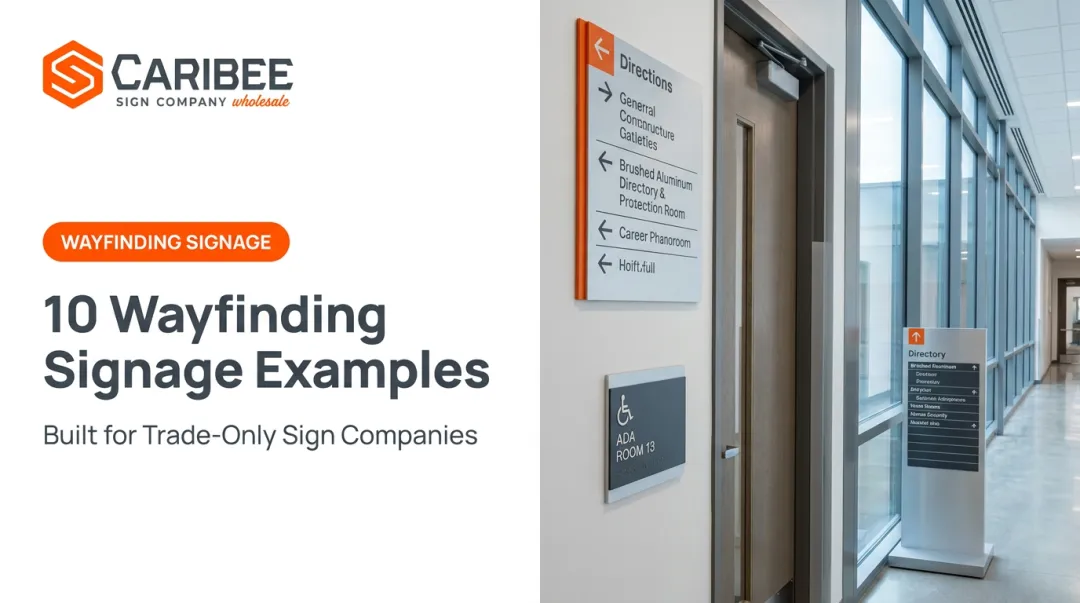
Informational signs give the bigger picture: building directories, floor plans, amenity maps, and tenant listings. These typically live in high-visibility areas like lobbies and elevator lobbies, where someone needs context before choosing a direction.
Regulatory Signage
Regulatory signs establish the rules: fire exits, occupancy limits, restricted-access areas. This category overlaps most directly with legally mandated ADA and life-safety codes, and it's the one businesses can least afford to get wrong.
ADA Compliance: The Non-Negotiable Foundation of Office Wayfinding
Any permanent room sign in a commercial office, think restrooms, stairwells, conference rooms, must meet the 2010 ADA Standards for Accessible Design. It's enforceable code, meaning noncompliance carries real legal risk.
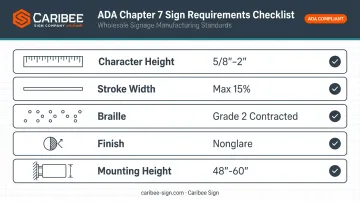
The U.S. Access Board's Chapter 7 standards spell out specifics that sign buyers need to verify before an order ever leaves the shop floor:
- Character height: 5/8 inch minimum to 2 inches maximum, measured from the baseline
- Stroke width: Maximum 15% of character height
- Braille: Contracted (Grade 2) Braille with domed dots, placed below the corresponding text
- Finish: Nonglare, with light characters on a dark background or vice versa
- Mounting height: Baseline of tactile characters between 48 and 60 inches above the finished floor
Miss any one of these on a single sign, and it can trigger a Department of Justice complaint or a costly retrofit. The Missoula County settlement is a good example: room signs mounted without Braille and restroom signage lacking raised characters led to a full remediation requirement across the building, well after construction was already finished.
Here's the problem many sign companies run into: sourcing signage that consistently hits every one of these specs, order after order, at scale, is harder than it sounds. Braille dot spacing has tolerances measured in thousandths of an inch. Mounting heights get missed during install. Contrast ratios get overlooked when a client wants a specific finish.
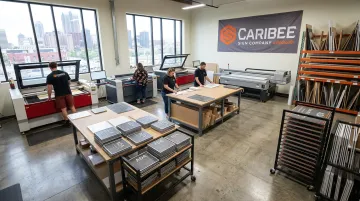
This is exactly the gap Caribee Sign was built to close. As a wholesale manufacturer working exclusively with sign companies and trade professionals, Caribee produces ADA and Braille signage in-house, handling Grade 2 Braille translation directly so partners never have to source it separately.
For a sign company juggling multiple jobs and multiple codes, having one manufacturing partner who gets compliance right the first time removes real risk from every order.
Key Benefits of Implementing Corporate Wayfinding Signage
Good wayfinding does more than help a company avoid fines — it changes how a workplace functions day to day.
It cuts down on wasted time and distraction. A Steelcase and Ipsos study found that the average worker loses 86 minutes a day to distractions, with nearly half reporting they struggle to concentrate at all. Confusing hallways and unmarked doors are exactly the kind of low-grade friction that adds to that number.
It shapes first impressions. A visitor, client, or job candidate who finds their way to the right conference room without asking twice walks away with a subtly better impression of the company. A lobby directory that's clean and legible signals the same thing a tidy reception desk does: this organization has its act together.
Long-term liability drops when compliance is built in from the start. Retrofitting a building after a complaint is always more expensive than getting the signage right during buildout. Proactive ADA-compliant signage investment avoids:
- Emergency remediation costs after a DOJ complaint
- Downtime from re-manufacturing and reinstalling signs
- Reputational fallout from accessibility failures
Design Principles for an Effective Wayfinding System
Compliance gets a sign in the door. Good design is what makes people actually use it correctly. Five principles guide most well-built systems:
- Consistency: Uniform colors, fonts, and symbols across the entire facility let people learn the system once and apply it everywhere
- Visual hierarchy: Destination and direction should be the first thing someone sees, with secondary details (like department codes) taking a back seat
- Simplicity and clarity: A sign should be understood in a few seconds; if someone has to stop and study it, it's already failed
- Accessibility: Tactile elements, high-contrast graphics, and correct placement make the system work for everyone, not just employees with typical vision
- Flexibility and scalability: Room names change, departments move, floors get reconfigured, so the system needs to be easy to update without a full redesign
Skip any one of these principles, and the whole system gets weaker.
A perfectly ADA-compliant sign that's inconsistent with the rest of the building still confuses people. A beautifully designed sign that isn't accessible still exposes the business to risk.
Choosing the Right Wayfinding Signage Partner
Not every sign shop can produce ADA-compliant work reliably at volume. When evaluating a manufacturing partner, sign companies and businesses should look for three things:
- Consistent ADA compliance across every product - not just the occasional sign, but every single order, every time
- Responsive communication - fast quote turnaround and someone who answers questions before they become production delays
- Reliable turnaround and fulfillment - especially for multi-site rollouts where timing across locations actually matters
That first criterion, consistent ADA compliance, is often the hardest one for sign companies to deliver in-house on every job. Braille translation, tactile tolerances, and mounting specs all require attention that most shops would rather not staff internally. Partnering with a specialized manufacturer shifts that burden off their plate entirely.
Caribee Sign has operated on this wholesale, trade-only model for more than 60 years, running production out of a centrally located St. Louis facility that ships nationwide. That structure lines up with the company's own positioning:
ADA-Compliant Signage Solutions Delivered with Quality & Care
Partners consistently point to fast quote responses and dependable delivery as the reason they keep coming back for repeat orders. That kind of friction reduction matters most when sign companies are the ones on the hook to a client.
Frequently Asked Questions
What are the 4 types of wayfinding?
The four common categories are identification signs (confirming arrival), directional signs (guiding movement), informational signs (like directories), and regulatory signs (like fire exits or capacity limits).
What are the five principles of wayfinding?
Most practitioners point to consistency, visual hierarchy, simplicity and clarity, accessibility, and flexibility. These aren't a single official ADA standard, but they're widely used as a practical framework for building effective systems.
What does a wayfinding designer do?
A wayfinding designer plans sign placement, visual systems, and user journeys through a building. They analyze foot traffic, decision points, and accessibility needs to make navigation feel intuitive rather than confusing.
What skills does a wayfinding designer need?
Key skills include spatial planning, graphic design, typography, and a solid grasp of ADA and accessibility requirements. Understanding how people actually behave in a space, often called user-experience thinking, ties these skills together.
Is ADA-compliant signage legally required in office buildings?
Yes, for permanent room identification signs like restrooms, stairwells, and conference rooms in most commercial buildings. Building directories and temporary signs used for seven days or less are generally excluded from this requirement.
How much does corporate wayfinding signage typically cost?
Costs vary based on material, order quantity, size, and compliance features like Braille and tactile lettering. Working with a manufacturer that gets compliance right the first time helps avoid the far larger costs of retrofitting non-compliant signs later.